Table of Contents
- Why Book a Hardscaping Consultation Before Starting Your Project
- How to Prepare for Your Hardscaping Consultation
- What to Expect During Your Paver Patio Design Consultation
- Questions to Ask Your Hardscaping Contractor Consultation
- Understanding Paver Patio Installation and Timeline
- Getting a Quote and Moving Forward
- Conclusion
- Frequently Asked Questions
Last Updated: October 19, 2026
Why Book a Hardscaping Consultation Before Starting Your Project
To book hardscaping consultation services is the most important step before investing in a patio, retaining wall, walkway, or any outdoor living space.
A consultation gives you clarity: a professional contractor assesses your space, identifies constraints you haven't considered, and walks you through realistic options, spotting drainage issues, utility lines, soil conditions, and site challenges that could derail a DIY attempt.
At Zero Trace, we've completed over 500 hardscaping projects across the region.
The consultation also protects your investment: a contractor recommends materials and installation methods built to last decades, explaining trade-offs so you choose based on facts, not guesses.
How to Prepare for Your Hardscaping Consultation
The more ready you are when the contractor arrives, the more useful the consultation becomes.
Assess Your Space and Property Constraints
Before you book hardscaping consultation services, walk the property and note the topography: level, sloped, or uneven? Slopes affect drainage, material choices, and installation complexity.
Identify existing features that matter: trees, shrubs, flower beds, and utility runs (gas, water, electrical, sewer). If you're unsure where utilities are buried, contact your local utility locating service before the appointment; they'll mark lines at no cost.
Check your property boundaries and any easements. Setbacks may apply near property lines, and easements can restrict what you build. Knowing these constraints in advance prevents wasted time on options that won't work.
Document Your Yard's Current Condition
Take clear photos and videos of the existing yard: the full space, close-ups of problem areas, and the angles where you'll see the finished project most.
Write down what's bothering you about the current setup: pooling water, unusable areas from poor drainage or uneven ground, wind exposure, lack of privacy, foot traffic patterns. These observations shape the design and material recommendations.
Measure key distances if you can. Rough numbers, like house to back fence or side yard width, help a contractor visualize the space and come prepared with relevant ideas. If measuring feels overwhelming, the contractor will do it during the consultation.
What to Expect During Your Paver Patio Design Consultation
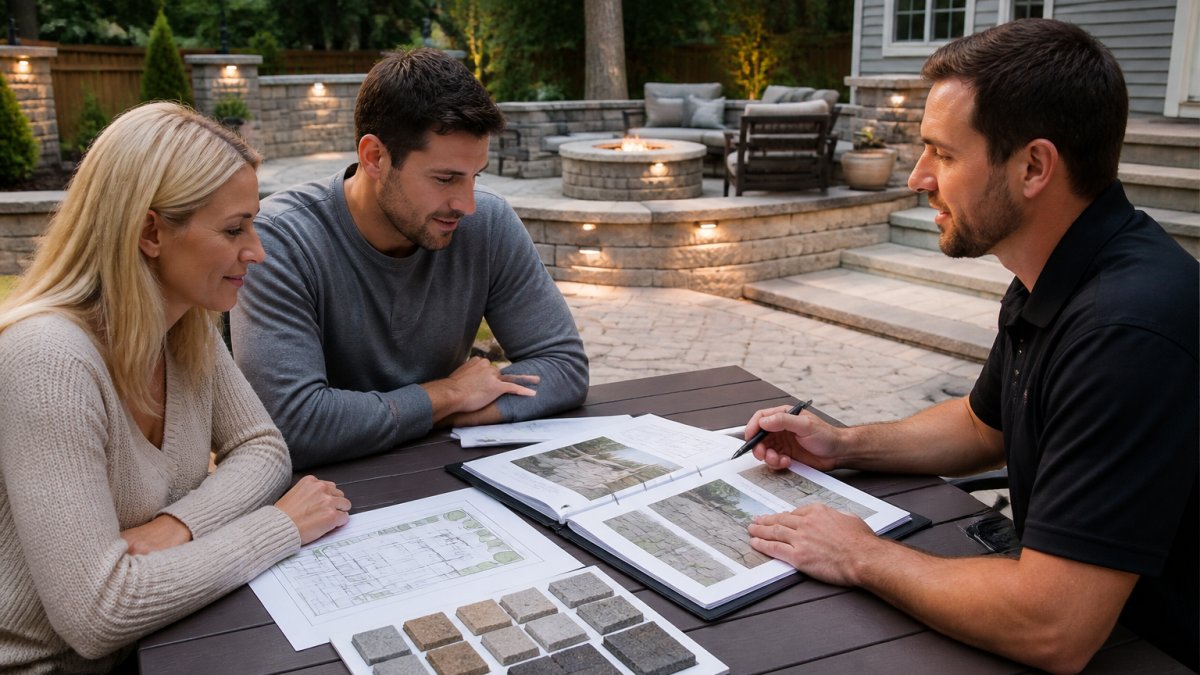
A hardscaping consultation typically lasts 45 minutes to an hour, but a good contractor's visit is more structured than most homeowners expect. It's a site assessment first and a sales conversation second. Understanding the sequence helps you judge whether the contractor is doing real work or just taking notes for a quote.
The Site Walk-Through
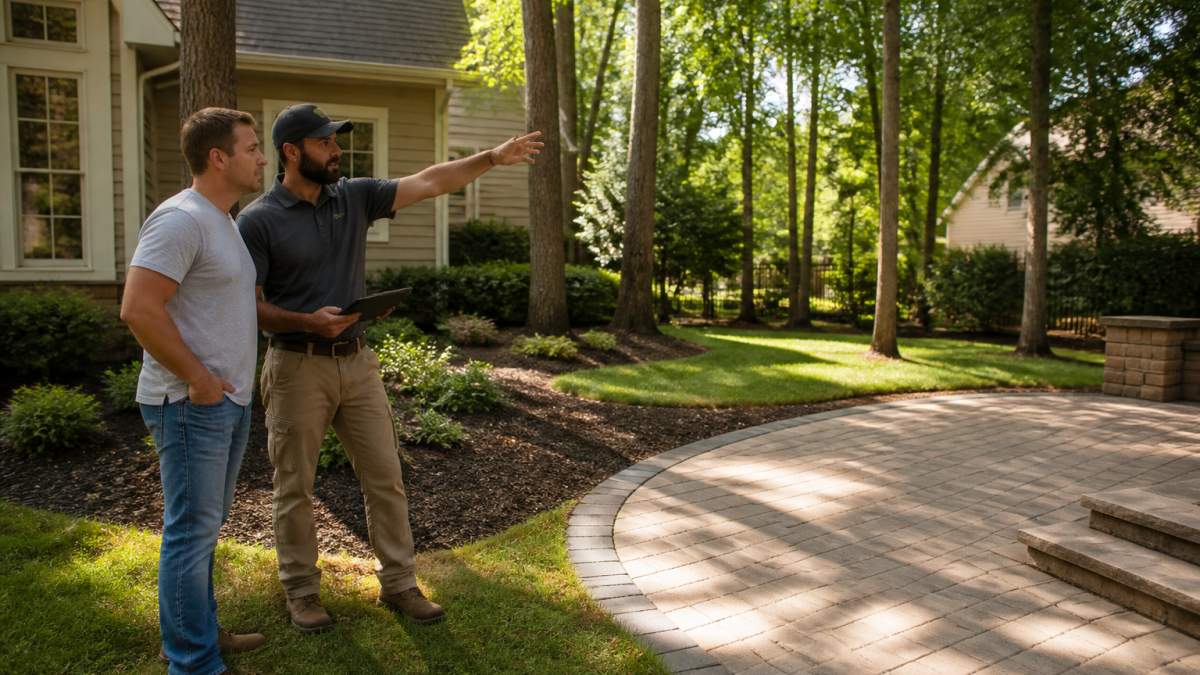
The contractor will walk the full perimeter of the proposed project area, not just the patio spot, looking at how water moves, where the grade changes, how the space connects to the house, and what existing features constrain the design. Expect checks on the slope away from the foundation, downspout and gutter discharge, and whether the yard drains toward or away from the structure.
In coastal Virginia, this step matters more than in most markets. Flat terrain, a high water table in many neighborhoods, and heavy summer downpours mean a patio that looks fine on a dry day can hold standing water after a storm.
Soil, Drainage, and Grade Checks
Expect the contractor to probe the soil, sometimes with a hand auger or shovel. Sandy loam drains well; heavy clay holds water and expands and contracts with moisture, which is hard on pavers and retaining walls.
They will also check the existing grade. A patio needs a slope of roughly 1 to 2 percent away from the house so water runs off. If the yard is flat or slopes toward the house, the contractor must build that slope into the design, which may mean importing fill or adding a step.
Utility Locating and Property Lines
Before any digging, utilities must be marked. The national 811 call-before-you-dig service is free, and most contractors will either call it themselves or ask you to. Ask who is responsible and when the mark-out will happen.
The contractor should also confirm property lines and easements. Patios, walls, and fire features placed too close to a property line can violate setback rules, and easements for drainage, utilities, or access can restrict what you can build. If you don't have a recent survey, say so; the contractor may recommend one before finalizing a design near a boundary.
Local Permitting Considerations
Not every hardscaping project needs a permit, but some do. Retaining walls above a certain height, structures with footings, and projects that change drainage patterns can trigger permitting requirements. The contractor should tell you which projects in your area typically require a permit and whether they handle the application or expect you to. Ask directly: "Will this project need a permit, and who pulls it?" A contractor who shrugs at that question is a risk.
Vision, Materials, and Budget Discussion
After the site walk, the contractor will ask how you want to use the space. Entertaining, quiet retreat, play area, and pet-friendly yard each push the design in different directions. They will then walk through material options, pavers, natural stone, retaining wall block, and the trade-offs in cost, durability, maintenance, and appearance.
By the end, you should have a realistic sense of scope, timeline, and a rough cost range. You won't have a final quote yet, since the contractor needs time to price materials and labor, but you should know whether the project is feasible, the main risks, and the next step.
Questions to Ask Your Hardscaping Contractor Consultation
Go into the consultation with a prepared list.
Ask about experience with projects like yours. How many paver patios and retaining walls have they installed?
Ask about their process and timeline. How long will the project take from start to finish?
Ask about materials and durability. Why does the contractor recommend specific pavers or stone? How long will they last? What maintenance will they need?
Ask about permits and utilities. Does this project need permits? Will they handle that, or is it your responsibility?
Ask about cleanup and site restoration. Zero Trace, for example, prioritizes meticulous cleanup, we treat your property like it's our own.
Ask about communication and scheduling.
Understanding Paver Patio Installation and Timeline
A paver patio installation isn't just laying stones. It's a sequence of steps, each building on the last.
Site preparation comes first.
Next comes the base layer. A compacted gravel or crushed stone base supports the pavers and allows water to drain through.
Edge restraints come next.
Then the pavers go down, laid in a specific pattern with consistent spacing, and sand fills the joints.
Finally, the joints are sealed or stabilized. Polymeric sand hardens when wet, locking pavers in place and preventing weeds.
The whole process typically takes one to three weeks depending on project size, weather, and complexity.
Getting a Quote and Moving Forward
After the consultation, the contractor will prepare a quote. Hardscaping estimates vary widely in format and detail, so understanding what a good quote looks like, and how to compare two fairly, is the difference between choosing well and choosing blind.
Do Consultations Cost Anything?
Most hardscaping contractors offer an initial on-site consultation at no charge, especially for residential projects; the free visit is a sales and assessment tool, and the contractor absorbs the cost in exchange for the chance to bid. Some charge a design fee for a formal plan, scaled drawing, or 3D rendering, sometimes credited toward the project if you hire them. Ask up front: "Is the consultation free, and is there a separate design fee?" Get the answer in writing.
What a Detailed Estimate Should Include
A good hardscaping quote is itemized, not a single lump sum. Look for line items covering excavation and grading, base material and compaction, drainage work, edging or restraints, the paver or stone material, joint sand or polymeric sand, labor, equipment, disposal of spoils, and cleanup.
Ask whether the quote includes permits, utility locating, and required inspections. Ask whether material prices are locked or subject to change, since paver and stone prices can move. Ask about the payment schedule, typically a deposit, progress payments, and a final payment on completion, and whether the contractor accepts a holdback until punch-list items are finished.
How to Compare Two or Three Bids
Get at least three quotes, and compare them line by line rather than by bottom-line price. A lower bid often reflects a thinner base, less excavation, cheaper materials, or omitted drainage work, all of which cost more later.
If one bid is significantly lower, ask the contractor to explain what's different. A legitimate contractor can walk you through the scope differences; if they can't, that's a warning sign. The middle bid from an experienced, well-referenced contractor is often the safer choice, but only after you've confirmed the scopes are actually comparable.
Checking References and Credentials
Ask for references from recent projects similar to yours, and call them. Ask whether the work was completed on schedule, whether the final cost matched the quote, whether the crew cleaned up, and whether the contractor returned calls after the job. Also confirm licensing and insurance: ask for a certificate of insurance showing general liability and workers' compensation coverage, and verify it with the insurer if you can. An uninsured crew on your property is a liability you don't want.
What to Clarify in the Contract
Before work starts, make sure the contract spells out the scope, materials and brands, start and completion dates, payment schedule, change-order process, and warranty. Ask what happens if the project runs over the quoted timeline or if unforeseen site conditions, such as buried debris or unstable soil, add cost. A clear contract protects both sides and prevents disputes.
Once you've compared the bids, checked references, and confirmed insurance and contract terms, you're ready to move forward. The consultation and quote process isn't bureaucracy; it's how you make sure the backyard you pay for is the backyard you actually get.
Conclusion
Booking a hardscaping consultation is the investment that pays for itself. You'll make better decisions, avoid costly mistakes, and end up with an outdoor space built to last. At Zero Trace, we approach every consultation as a partnership, we listen to your vision, assess your property honestly, and recommend solutions that fit your goals. Our fully insured, locally owned team has transformed over 500 properties across the region, and we stand behind our work with an on-time, every time guarantee. Request a quote from Zero Trace today and take the first step toward the backyard you've been imagining.
Frequently Asked Questions
What happens during a backyard hardscaping consultation?
A hardscaping consultant visits your property to assess the space, discuss your vision, evaluate site conditions, and identify constraints like utilities and drainage. They measure your yard, take photos, discuss material options, and provide recommendations based on your budget and goals. The consultation typically includes a walkthrough of the site, questions about your lifestyle and maintenance preferences, and an overview of the design and installation process. Most consultations last 30-60 minutes and result in a formal estimate or proposal.
How should I prepare for a hardscaping project planning checklist before the consultation?
Gather photos of yards or patios you like, measure your space if possible, note any underground utilities, and identify problem areas like poor drainage or shade. Document existing hardscape or landscaping features. Make a list of your must-haves (seating area, fire pit, garden beds) and your budget range. Clear the yard of clutter so the contractor can see the full space. Have property line markers visible and note any HOA restrictions. This preparation helps the contractor give accurate recommendations and speeds up the design process.
How much does a backyard hardscaping consultation cost?
Zero Trace offers consultations tailored to your needs. Contact Zero Trace directly for current pricing and to discuss your specific project.
What should I ask a hardscaping contractor before hiring them?
Ask about their experience with paver patio installation and similar projects, whether they're fully insured and licensed, their timeline and schedule, how they handle cleanup and debris removal, what warranty or guarantees they offer, and how they communicate during the project. Request references from recent jobs, ask about their process for handling unexpected issues, and confirm their on-time performance record. Understanding their approach to project management and problem-solving helps you choose a reliable partner for your outdoor transformation.